


For the 24 years since graduating from college, I have worked exclusively in sales.
It all started at Yoshida & Co.
I joined Yoshida & Co. as a new graduate because I was drawn to their corporate philosophy: "Isshin Nyukon" (devoting one's heart and soul to every single stitch).
I was already familiar with PORTER. I had seen Takuya Kimura wearing a TANKER in a TV drama, and the more I researched the company during my job hunt, the more I was attracted to their approach to craftsmanship.
At the time, I couldn't find information about new graduate recruitment on their website. So, I called the company directly to ask how to apply.
After receiving an offer, I attended sales training at their Marunouchi shop every Saturday before officially joining the company. During that training, a senior colleague said something to me:
"Expectation is not reality."
Once I joined, I learned that it wasn't all glamour.
It was still a small, elite team with a strict hierarchy—what you might call a "typical company." Back then, I was a bit cocky about the world. My seniors hammered the fundamentals of work and how to approach manufacturing into me.
I was in charge of the Marui department, and I examined every single one of the 30-plus repairs that arrived each week.
How should it be fixed? What is the repair cost? How did the customer use it, and why did it break?
My seniors often told me:
"Yoshida & Co. is not a fashion house; we are a bag maker. A bag is useless if it doesn't function properly."
That was the phrase they lived by.
For me back then, "Isshin Nyukon" was just a word that naturally existed within the company.
I was taught that being a professional meant pouring your soul into every stitch and approaching everything—even repairs—with absolute seriousness and focus.

I spent three years and one month at Yoshida & Co.
On April 1st, after completing exactly two years at the company, I decided, "I want to quit a year from now and work in apparel," and I requested materials from Vantan that very day.
When I eventually resigned, I think the excitement of finally pursuing the apparel work I wanted to do outweighed any sadness.
At that time, I never once imagined that 20 years later, I would end up working with Yoshida & Co. again.
Later on, as I became involved with doublet, I began to think, "Wouldn't it be great if doublet and Yoshida & Co. could do something together?"
doublet’s "seriously playful" approach and Yoshida & Co.’s "Isshin Nyukon."
At first glance, they seem completely different, but both are deadly serious about their craftsmanship.
About three years ago, I mentioned it to Ino-san.
His response was something like,
"That sounds fun!"
I think that was about it (laughs).
Honestly, I think Ino-san didn't really know what kind of company Yoshida & Co. was at the time, so his reaction was quite light.
But I really wanted to make it happen, so I impulsively sent a DM to Matsubara-san, who I’d worked with in the same department during my time at Yoshida & Co.
About a year after that, the collaboration finally started to move.
Once it actually began, I was a little worried precisely because I was a former Yoshida & Co. employee.
Ino-san has no rules or preconceived notions—in a good way.
On the other hand, Yoshida & Co. must ensure that every idea ultimately results in a "proper bag."
In the early stages, there was an idea to use the face of the PORTER character itself on a bag, and I remember thinking,
"What am I going to do about this..." (laughs).

But as we held more meetings, the Yoshida & Co. team stopped ending the conversation with "we can't do that" and instead started thinking about how they could make it a reality.
"We want to do our best to meet doublet's vision, so we'll do everything we can."
When they said that, it felt less like two companies working together and more like we had become a single team.
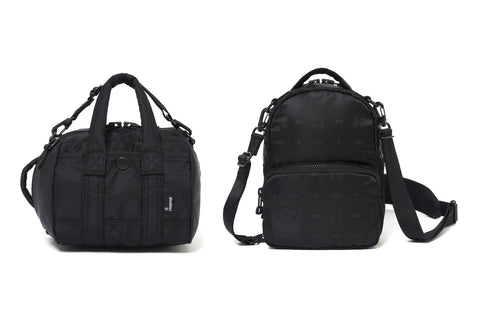
When I saw the finished bag, I thought, "This is both very doublet and very Yoshida & Co."
And when I saw that bag being used at a Paris show, I felt that something which had started from my own personal desire had left my hands and become a piece of "doublet and POTR."
In fact, when this project started, I had just left a company where I’d worked for 10 years and had gone independent as a freelance salesperson.
So, to be honest, there was a part of me that was calculating,
"I hope this collaboration becomes my job and brings me some profit."
If it were the old me, I probably would have wanted to show the world,
"I’m the one who made this collaboration happen."
There was a part of me that wanted to "prove something" to my former self.
But as the collaboration progressed, those feelings gradually faded.
Before I knew it, I was simply happy that such a seriously playful bag had truly come to life, far more than I cared about "who connected it" or "how much I would profit."
If someone is carrying this bag and says,
"Whose bag is that?"
"It's a collaboration between POTR and doublet."
"It’s quirky, but it’s actually really well-made."
If that kind of conversation happens, that would be my greatest joy.

If I could tell my younger self who joined Yoshida & Co. 24 years ago about today, I think I would say:
"I’m proud of you for choosing to join Yoshida & Co. out of all the companies out there."
At the same time, I would also say,
"It was only three years, but I wish I had cherished those three years a little more."
Back then, I didn't know if quitting was the right choice.
Even now, I don't know what would have happened if I hadn't left.
But I am who I am today because I left back then.
And, more than 20 years later, through my work with doublet, I have felt the true weight of the "Isshin Nyukon" philosophy I was taught at that company once again.
Just as I used to look at each repair piece and think about how to make it usable again, the Yoshida & Co. team didn't shoot down doublet’s wild ideas, but instead thought about how to make them work as real bags.
Watching them, I remembered the phrase "Isshin Nyukon," which I used to take so for granted.
I feel I understand the meaning of that phrase much more deeply now than I did then.
Life is unpredictable—you never know how or where things will connect.
Looking at this bag, that is what I thought.