


Test tubes. Microscopes. Lab coats. Labs.
These were the images that came to mind.
When I first heard the explanation of Aircarbon, to be honest, it didn't quite click for me.
They said that microorganisms consume methane and air, and then create the material within their cells.
And finally, it turns into beads and sits in my hand.
"Maybe because it's made from air, it feels lighter than regular beads."
It's probably not that simple.
But I decided to think of it that way.
Gas turned into a solid.
That's already 4-dimensional.
It all started with one cow.
The research for Aircarbon apparently began after reading an article about a cow named "Lucy" over 20 years ago.
The question was, could the methane emitted by cows be transformed into something valuable?
They've been researching it for over 20 years since then.
Amazing.
I was quite anxious about a mere few weeks' delay in delivery.
20 years.
And the people at Newlight (Newlight Technologies, Inc.) who are developing it say,
"We're just getting started."
Yikes!
Where are they planning to go?
I really want to know their destination in detail.
Creating classic pearls with future materials.

Actually, they weren't originally trying to make beads.
Ino first contacted Newlight because he found a leather-like material made with Aircarbon and thought, "I want to use this for clothes."
After a while, a sample of the material arrived.
Inside the box, along with the leather sample he had requested, was a small bracelet.
It was a gift from Newlight.
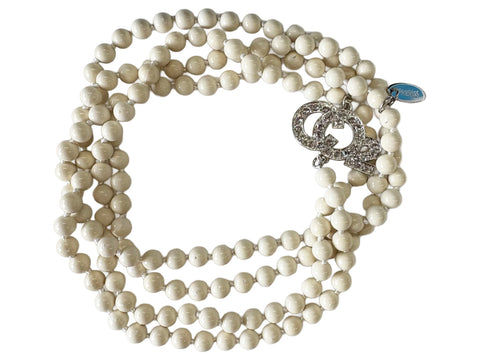
A bracelet of pearl-like beads made from Aircarbon.
Ino saw it and thought,
"Huh? This is also made from air?"
And he touched it.
It had an indescribable texture, unlike anything he had seen before.
Then, the conversation about the leather he wanted to use went somewhere else entirely.
"I want to make accessories with this that no one has ever seen before."
It was sudden.
But, according to Ino,
"There are moments when an unexpected encounter with a material like this completely captures your imagination. That's what makes being a designer truly happy."
So it seems.
Thus, the decision was made to turn Aircarbon into beads and create pearl-like accessories.
I like this combination.
Turning a future material born from air and methane into traditional pearl jewelry.
Californian scientists.
Japanese artisans.
doublet.
People from completely different places suddenly intersect within a single necklace.
It's like an omnibus novel.
By the way, the beads were milky white.
After hearing that the story began with a cow,
they started to look a bit like milk.
Humans are simple creatures.
Even future materials have deadlines.
Of course, it's not all pretty stories.
Newlight didn't yet have a method for mass-producing the desired size of beads in the quantity we needed.
They had to remake the mold from scratch.
I'm grateful.
Truly grateful.
However, my honest opinion was,
"Even if it's an eco-friendly future material, delays in delivery are still a problem."
Even if we live in the future, deadlines are in the present.
Nevertheless, Newlight didn't give up and continued to produce until the very end.
Japanese artisans also consulted with us almost daily, trying to make up for lost time.
There were more people involved than I expected behind a single small accessory.
Manufacturing cannot be done alone.
It's obvious, but you realize it anew in situations like this.
The "Did it become normal?" incident.

The final beads turned out to be a bit creamier than the initial sample.
My first impression was,
"Huh! In a way, hasn't it become… ordinary?!"
It looked a bit different from the sample buyers had seen.
Is this okay?
I consulted with Ino.
Indeed, the color had changed.
But it was the result of Newlight's trial and error for mass production, not just for this time, but to create a method that could handle similar orders in the future.
Ino said,
"Then, let's make this cream color the best it can be right now."
Instead of trying to somehow reproduce the initial sample, they decided to face the product created by a method that could be continued in the future.
Instead of saying, "It turned this color,"
"How good can we make this color?"
That was the thought process.
I see.
When I looked at it again with that thought in mind……it was cute.
Moreover, there was a proper reason for the color change: the mold and molding conditions had changed.
Hearing that,
"It feels somewhat precious,"
I thought.
It wasn't just randomly creamy.
Manufacturing isn't just about restoring things that aren't as planned to their original state.
Make it the best it can be right now.
In manufacturing, such changes in direction happen occasionally.
I hope the Doublet Effect happens.
One accessory won't solve the world's environmental problems.
I know that.
"Precisely because doublet is a company of this scale, we can be the first to dive into new materials."
Ino often talks about this.
Using materials like Aircarbon, which are not yet mainstream.
Naturally, when trying to mass-produce, situations like "how do we make this?" arise, just like this time.
Nevertheless, because we are of this scale, there are things we can "give a try."
And then, present it at Paris Fashion Week, a place where the attention of fashion professionals worldwide gathers.
According to Ino,
"I think it's enough just to let people know that such a material already exists."
Someone who sees it might use that material next.
Someone else might use it.
Someday, even big companies might start saying, "We want to use this."
If more people want to use it, the producers of the material can take on new challenges to produce even more.
As it slowly becomes more visible,
it will eventually no longer be called a "future material,"
and simply become a commonplace material.
A small action generates the next small action.
Listening to Ino's story, I secretly started calling it,
not the Butterfly Effect, but the
Doublet Effect.
Instead of "having to choose" it because it's good for the environment,
"I genuinely want this."
And what they bought, it turns out, was made from air and methane.
I think such a future would be quite enjoyable.
Whose air is in these beads, I wonder?

Looking at the finished accessories, I sometimes think strange things.
Since it's made from air and gas,
isn't there a very, very tiny trace of the breath of people and animals from the past, who were important to us, still somewhere in the world's air?
And what if a part of that is in these beads?
It's entirely my fantasy.
Scientists might correct me.
But thinking that way is a bit fun.
The people at Newlight.
Japanese artisans.
doublet.
Fashion retailers around the world.
And the person wearing this accessory.
Everyone becomes a character in the same omnibus story through these small beads.
I hope that happens.
And finally,
"doublet is always doing various things with various people, when you think about it."
If people can think that,
that's enough.
About Newlight Technologies / Aircarbon
Newlight Technologies, Inc. is a company based in Huntington Beach, California, USA, that researches, develops, and manufactures Aircarbon. With its headquarters and commercial production facilities located in the same place, it consolidates research, engineering, and manufacturing to develop new applications and scale up production.
Research into Aircarbon began over 20 years ago. It was triggered when the founders of Newlight Technologies read an article about the methane emitted by a cow named "Lucy," which led to the question: "Can methane be transformed into a valuable material instead of merely being an environmental burden?"
Subsequently, they focused on the work of microorganisms found in the ocean. When methane that would otherwise be released into the atmosphere and air are fed to these microorganisms, they absorb them and produce a substance called PHB (polyhydroxybutyrate) within their cells. Aircarbon is created by extracting and refining this substance. This manufacturing method is inspired by the natural carbon cycle that has long occurred in the ocean.
Currently, Aircarbon is being expanded into various fields, including fashion, packaging, and durable goods.
The content of the email interview with Mark Herrema, CEO of Newlight Technologies, Inc.,
will be published at a later date.