


Following Pleats Inc. last time, this time I visited Aono Pile Co., Ltd. in Wakayama Prefecture, who accepted the challenge of making fleece using "air yarn."
How did the artisans who have continued to make pile fabrics manage to transform "air yarn" into fabric? I spoke with Managing Director Aono along with designer Ino.
The Yarn That Couldn't Be Knitted

Masao Aono, Managing Director of Aono Pile Co., Ltd.
"I thought it was a yarn that couldn't be made into clothing,"
That's what Aono-san thought when he heard the request to knit fleece from "air yarn."
"Air yarn" is a POM resin-derived yarn that uses carbon dioxide as part of its raw material, and doublet affectionately calls it that.
Aono-san had previously dealt with polyacetal resin-derived yarn for a different project, which had a different manufacturing method than Pleats Inc. That yarn was completely inelastic and stiff, and when put on a machine, "it couldn't be knitted at all."
He expected the yarn brought by doublet to be similar, but when he actually held the delivered product in his hands, it was a little different.
"When I saw the yarn, we agreed that it could be knitted. It felt similar to the polyester and nylon we usually use, so I thought it might work."
Too Hot and It Gets Stiff
Although they started with the thought, "This might be knit," they faced a major challenge at the actual site. The biggest issue was "heat."
Normal fleece is finished by applying high temperatures (around 150-170 degrees Celsius) to stabilize the fabric's shape. It's similar to ironing clothes to make them look neat.
However, air yarn has the property of becoming hard when heated above 100 degrees Celsius. If processed by normal methods, the fabric would become stiff.
Aono-san repeatedly emphasized this to the processing factory.
"Whatever you do, don't let it go above 100 degrees. It will harden."
With detailed temperature control requested from the surprised workers, fleece production using "air yarn" began with a lower temperature setting than usual.
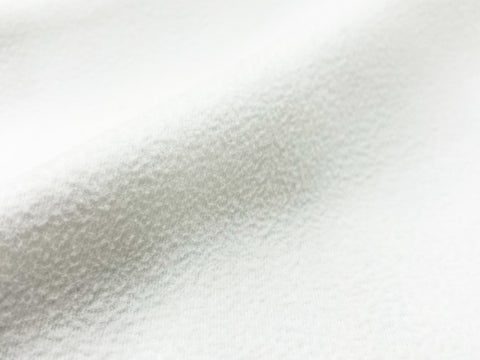
After repeatedly facing difficulties different from conventional materials, such as yarn snagging and minor thread breakage, a pure white fleece fabric was finally knitted.
From Oddball to Outstanding

However, even at this stage, Aono-san said he didn't quite grasp "how this would become clothing."
Ino also recalled, "I wondered how to turn this into clothes, but even more, I was happy that 'this really came from air!'"
And the next obstacle they encountered was the "color" barrier.
Air yarn is difficult to dye evenly and consistently because its dyeing is unstable and it cannot withstand high temperatures.
So, they changed their approach.
Instead of aiming for "perfect dyeing," they wondered if the difficulty in dyeing itself could be incorporated into the garment's appearance. They tried pigment dyeing, aiming for a mottled texture like vintage clothing.
As a result, the color took well to the surface.
The pigment dyeing created a unique, slightly shrunken texture in the fabric.
The impression changed dramatically from the pure white texture before dyeing, and it became a vintage-like fleece with a rich character.
Difficult to dye. Shrinks. Cannot withstand heat.
In the past, these would all have been considered "flaws" in manufacturing.
This time, however, they transformed into a unique characteristic of this fabric.
The moment he saw its expression, Ino instinctively exclaimed, "Yes, yes!"
"This isn't our fabric,"
Normally, a factory's work is finished once the fabric is knitted and delivered.
But this time, they had the opportunity to see the finished garment, and Aono-san involuntarily exclaimed, "Oh, amazing!"
"If I hadn't known anything, when shown doublet's fleece, I would have said, 'This isn't our fabric,'" Aono-san said with a laugh.
The fabric had changed so much that Aono-san himself felt it was "not our fabric."
Those words from the creator felt like the highest compliment for this garment.
This is because they were able to bring out an unprecedented expression from that fabric through skill and ideas.
More than anything, I was happy to see Aono-san's smiling face, who took on the challenge of creating something new and was genuinely delighted and amused by the finished product.


Beyond "Can't Do It"
After the interview, we were given a tour of the factory where the fabric is actually knitted.

Around the knitting machine that knitted this fleece, 120 spools of white yarn were lined up, and from each one, the yarn was unwound, gradually forming a three-dimensional fabric.
Several knitting machines were operating, and the artisans were intently monitoring the condition of the yarn.
Looking only at the finished fabric, the process is invisible. However, there was a time when 120 threads moved simultaneously, and a scene in the factory where human hands were definitely involved.
I honestly felt that I wanted as many people as possible to know about the atmosphere and interesting aspects of this craftsmanship through clothing.
Handling air yarn was not easy, and there were numerous challenges, but each time, instead of ending with "it can't be done," they thought about "how it could be done" and overcame them.
The difficulty in dyeing, the shrinkage, and the weakness to heat all transformed into unique expressions of this fabric.
The fleece made from air yarn is not just made from a new material. It is filled with the invisible efforts of people who kept working beyond "can't do it."
Aircarbon, born from "air."
The story of how air becomes beads continues in the next chapter.