


doublet's Autumn/Winter 2026 collection, themed "AIR".
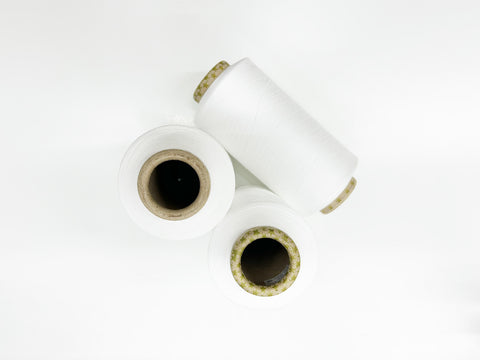
Among them are clothes made from threads derived from resin, with some of the raw material being carbon dioxide. Doublet calls this thread "air yarn".
Clothes made from this yarn are finally going to be released.
The opportunity to learn about this material came in a car, on the way to Choshi Port with Mr. Funasaki of Morito Apparel, to discuss fishing net recycling.
When I heard his casual remark, "Did you know that yarn can be made from natural gas?", I felt the potential for new clothes to be born from a material I had never seen or touched before.
Later, Mr. Funasaki introduced me to Pleaisir Co., Ltd., where I actually encountered the "air yarn" derived from resin using carbon dioxide.
However, if you're told, "We made yarn from air," not many people would immediately understand. What's more, when I, as the designer who actually used this material to create a collection, try to explain it, my head feels like it's going to start smoking.
So, in order to convey this unfamiliar "air yarn" in a way that is as easy to understand as possible, I went back to interview Chairman Toshikazu Umemura and President Satoko Shiroguchi of Pleaisir Co., Ltd., the developers. I believed it was meaningful for me to hear it myself and then convey it myself.
Chairman Umemura, looking back at his past, spoke about Pleaisir's journey from his days as a company employee immersed in research to the present, even interjecting humor. Words poured out one after another.
I tried to seize a momentary gap, waiting for the right timing to insert my prepared questions, and then fired off a heartfelt question.
What is “Air Yarn”?


First, I honestly expressed my feelings to the two of them.
"When I try to explain this air yarn, my head feels like it's going to start smoking. For example, how would you explain it to a five-year-old so they could understand?"
When I asked that, the answer came immediately.
"You know dry ice, right? We can turn that cold dry ice into a fiber."
I see. Air is invisible. However, carbon dioxide, which exists in the air, becomes visible when it turns into dry ice. If it's a visible solid, then by making it extremely thin, it can become a thread — I, as a designer, could imagine that.
So, how would they explain it to a middle school student?
"Bring carbon dioxide and hydrogen, put them in a frying pan, and heat them up, and they become an alcohol called methanol. Then, use that to make a resin, stretch it thin, and turn it into a fiber—I think that explanation is easier to understand."
Of course, in reality, it's not something that can be easily made in a frying pan. Nevertheless,
Methanol is created from carbon dioxide and hydrogen.
Based on that, a resin called POM (polyacetal) is synthesized.
That resin is stretched thin to become a fiber.
As this series of steps became clearer, the smoke coming from my head gradually began to dissipate.
"It's easy to explain to a chemist from a chemist," said Chairman Umemura.
Developing difficult technology and conveying it to people without specialized knowledge presents another kind of difficulty. I felt glad I came here to confront that challenge.
Galileo, the eccentric

From left: Chairman Toshikazu Umemura, President Satoko Shiroguchi, and Director Takao Umemura
The year was the 1970s.
Chairman Umemura, who began researching synthetic resins at Mitsubishi Gas Chemical, was engrossed in the study of creating a resin called POM (polyacetal) using methanol as a raw material. At the time, methanol was produced from natural gas, but in recent years, it has become possible to produce methanol from carbon dioxide instead of natural gas.
Air yarn also creates POM resin using carbon dioxide as part of its raw material and then processes that resin into fiber. Although Chairman Umemura at the time had no way of knowing it, this research became the starting point that would later lead to air yarn.
After several years of research and development, Chairman Umemura created a unique synthesis process to produce POM resin from methanol.
President Shiroguchi, Chairman Umemura's daughter, reflects on her father at the time:
"He only thought about his work. Even during meals, he would trace spilled miso soup with his finger and draw designs on the table. My mother was so exasperated that she told him, 'If you're going to go that far, just focus on your work and don't worry about the house.'"
The image of him seeing spilled miso soup and drawing designs on it while contemplating his work. It reminded me of a scene in the drama "Galileo," starring Masaharu Fukuyama, where he starts writing mathematical formulas anywhere to solve a case.
I'm sure this person dedicated all his time to research.
Now, I saw a parent and child laughing together about those fond memories. I don't know how the family felt at the time. Nevertheless, it must have been his family who created an environment where Chairman Umemura could devote himself so much to research. I felt strangely convinced.
Still, could someone really dedicate their entire being, their life, to research and work?
Within that time, there must have been hundreds, if not thousands, of failures. Yet, how was he able to continue without giving up?
When I asked that question, the answer I received was "defiance."
Defiance with a reason

At that time, methods for producing POM resin had already been established by American companies and others. Chairman Umemura, who began his research about 15 years later, needed to find a more rational manufacturing method rather than merely following existing ones, in order to succeed as a latecomer.
Chairman Umemura decided to develop a unique method different from existing ones.
However, the company's instructions were: "That method won't work. First, use the established method. You can pursue your own development after that, can't you?"
"It can't be done."
Hearing those words sparked a rebellious spirit in Chairman Umemura. When told "it can't be done," it ignited a determination to "go for it."
During working hours, he conducted experiments using the method instructed by the company. After that work was done, he continued experimenting with his own believed method until late at night.
He continued this demanding schedule, pursuing two lines of research simultaneously, for a year.
A year later, when the experimental results from both methods were presented, Chairman Umemura's unique method significantly surpassed the company's instructed method.
A few years after that, the synthesis and mass production of POM resin using his unique method progressed, leading to large-scale production in countries like South Korea, China, and Thailand, generating substantial profits.
The method that was once deemed "impossible" became a technology that brought profit to the company.
The Man Who Researched the "Impossible"
However, the story did not end there.
As the patent for the technology developed by Chairman Umemura expired and time progressed, by the 2000s, many countries began manufacturing POM resin. Production increased, and price competition intensified.
To create a new market, Chairman Umemura considered turning POM into fiber. However, Mitsubishi Gas Chemical was not a fiber company. Within the company, strong voices urged him to "give up on that."
Nevertheless, Chairman Umemura, who was then a managing director, pushed forward with research into fiberization.
The fiberization of POM resin had been researched by overseas companies and Asahi Kasei before, but it had not yet reached practical application.
Moreover, it was Chairman Umemura's first time researching fibers.
From there, a decade of research began.
However, within the remaining time as an employee, he couldn't fully achieve fiberization.
The person who had previously overturned things that were said to be "impossible" now retired from Mitsubishi Gas Chemical as "the person who researched the impossible."
At that time, Chairman Umemura felt the prevailing sentiment within the company was, "See, I told you it couldn't be done."
However, a researcher who burns brighter the more they are told something is impossible would not stop researching just because they retired.
"Alright, just you wait. I'll do it even if I'm alone," he thought, and his flame burned even brighter.
After retirement, he founded his own company and continued research into POM fiber.
His family, who once looked on with exasperation, thinking he only cared about work, now supported Chairman Umemura as he struggled alone. Furthermore, with the cooperation of Kyoto Institute of Technology and the support of many people, the research into fiberization continued.
To change the prevailing sentiment of "it can't be done" into "it can be done."
The Moment the Atmosphere Changed
Then, the times unexpectedly caught up with his long-standing research.
Mitsubishi Gas Chemical, which had the technology to produce POM resin from natural gas, was now researching how to capture carbon dioxide and use it as part of the raw material to produce POM resin.
Even if the entry point for the raw materials is different, the resulting POM resin is the same.
Twenty years after starting the research into POM fiberization at Mitsubishi Gas Chemical.
Finally, they achieved the fiberization of POM resin produced using carbon dioxide as part of the raw material.
Not only did it change the surrounding "it can't be done" atmosphere, but it also gave birth to "air yarn" that could even turn the air itself into fiber.


1% of the Future
What does Chairman Umemura think about the future of air yarn?
"Currently, 100 million tons of chemical fibers are produced worldwide. For example, producing 1 ton of polyester emits 2.8 tons of carbon dioxide. That's why I'm thinking of producing 100 million tons of polyacetal fiber. People say I'm crazy when I say that,"

He said with a laugh. However, he continued:
"Well, even if 100 million tons is impossible, I want to change 1%. That's 1 million tons."
Even 1 million tons, by current standards, is a number that would likely be deemed "impossible."
However, coming from a person who has turned "impossible" into "possible" every time he was told it couldn't be done, it didn't sound like just a grand dream.
Chairman Umemura, who has transformed what was said to be impossible into possible.
He changed the "it can't be done" atmosphere around him, and in the end, he turned the air itself into yarn.
The Values of Luxury
There are many materials and yarns in the world.
So, what defines a "luxury" material?
Is it silk? Is it cashmere? Is it something expensive, rare, and accessible only to a select few?
I believe that the value of a material isn't determined solely by the rarity of the raw material itself.
It encompasses the time and technology invested in it. The tenacity of those who persevered through countless failures. The lives of those who transformed what everyone thought was impossible into possible.
All of these are also part of the material.
The "air yarn," born from Chairman Umemura's extraordinary investment of time and his transformation of what was believed to be "impossible" into "possible," is for doublet an unparalleled luxury material.
That's why I didn't want to design this yarn into something futuristic; instead, I wanted to make clothes that blend into everyday life, like something you'd find in a vintage store.
I still remember the excitement I felt when I first encountered this material and saw the fabric woven from this yarn.
This is made from air. I am touching air now.
I've touched many fabrics before. Yet, the future I felt from this seemingly unremarkable white fabric was unlike any other material. The future might be closer than we think.

Fleece knitted with "air yarn."
The story of how the yarn became fabric continues in the next installment.